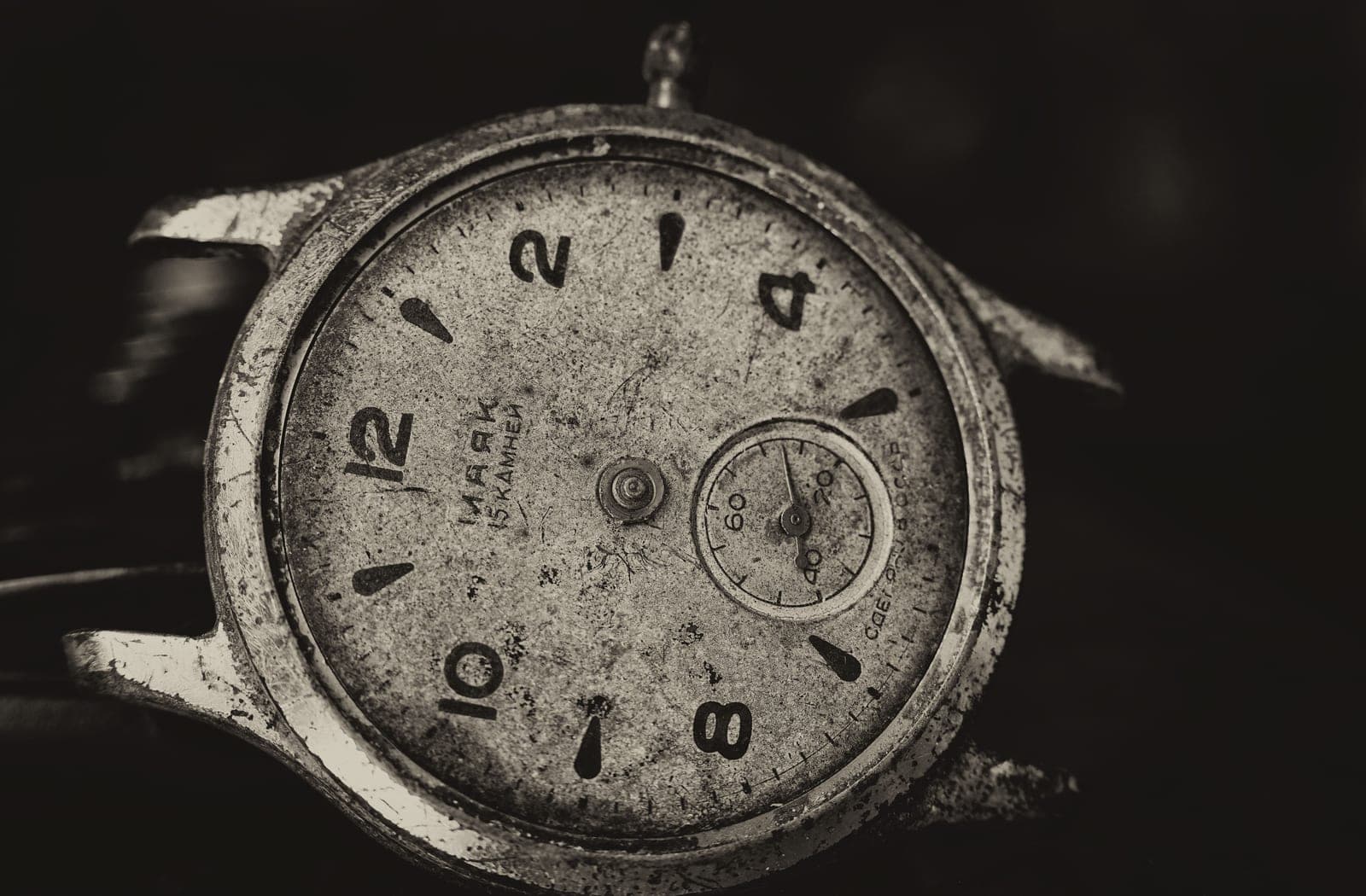
Automatic watches
How long do automatic watches last?
Indefinitely, with one condition that has nothing to do with how well it is made — and everything to do with which movement is inside.
By Sawyer V. · Published
The short answer
An automatic watch lasts as long as parts remain available for its caliber, because every component can be cleaned, lubricated or replaced. In practice that means a high-volume, in-production movement like Seiko's 4R or the Miyota 9000 series can be kept running essentially indefinitely.
The answer people expect is a number of years, and there is not one — which is the genuinely interesting part. A mechanical watch has no lifespan in the way a phone or a car does, because there is no component whose failure ends it.
Bearings wear, oils degrade, mainsprings weaken, gaskets harden. All of them are replaceable. A hundred-year-old pocket watch running today is not a survivor of unusual build quality — it is a watch somebody kept fixing.
The five ways an automatic actually dies
- Water gets in, and corrosion does the rest. By a wide margin the most common end. A hardened gasket, a crown caught on a sleeve, a hot shower. Rust does not polish out and a corroded movement is frequently uneconomic to save.
- Parts run out. An obscure or long-discontinued caliber reaches the point where no new parts and no donors exist.
- A hard impact breaks something structural. Rare, and usually repairable — a broken balance staff is a routine job on a common caliber and a serious problem on an unusual one.
- Neglect compounds. An unserviced movement runs dry, metal wears against metal, and a $176 overhaul turns into a parts replacement.
- It becomes uneconomic. The commonest quiet ending: a repair costs more than the watch is worth, and the watch goes into a drawer. This is a judgment, not a failure, and it is why a published service price matters so much.
Notice that four of those five are avoidable, and none of them is "it wore out".
Which calibers will still have parts in 2060?
Nobody can promise this, and the honest proxy is production volume. Movements made in the millions have parts supplies, donor movements and trained watchmakers for decades after production ends. Movements made in small numbers do not.
| Caliber | Position | On this site |
|---|---|---|
| Seiko 4R35 / 4R36 / 4R34 | Enormous volume; Seiko publishes a $176 overhaul price | Seiko 5 Sports, Prospex Turtle, entry GMTs |
| Seiko Instruments NH35 / NH38 | The same architecture sold to the whole industry | BOLDR Venture, and most microbrands |
| Miyota 9000 series | Very high volume, sold industry-wide | Baltic Aquascaphe |
| Seiko 6R35 / 6R55 | High volume, published $296 overhaul | Prospex Alpinist, SPB453 |
| Orient F6xxx | In-house, high volume, no published price list | Kamasu, Bambino, AK00 |
| Swatch Group Powermatic 80 / H-10 | High volume across Tissot, Hamilton and others | PRX, Le Locle, Khaki Field |
| Unnamed movements | Unknowable | Timex automatics — no caliber published |
That last row is the reason we deduct points for it. A watch whose maker will not name the movement cannot be assessed on the criterion that decides its lifespan.
Can an automatic watch last forever?
Functionally, close to it — but there is a philosophical edge worth naming. Replace the mainspring, the balance staff, the jewels, the rotor and eventually the whole movement, and at some point it is a watch of Theseus.
Practically, nobody cares, and they are right not to. A watch that has been serviced for sixty years and has had parts replaced is the same watch in every way that matters to the person wearing it. "Forever" means "there is never a point at which it cannot be brought back", and for a common caliber that is true.
How to make yours outlive you
- Buy a common caliber. This is 80% of the answer and it is decided before you own the watch.
- Keep the water out. A $60 partial service every few years — gaskets and a pressure test — addresses the leading cause of death for a fraction of the cost of an overhaul.
- Service it, or decide not to deliberately. Seiko says three years. Skipping is a defensible choice on a cheap watch; drifting into it is not.
- Write down the caliber. In 2060 a watchmaker who knows it can help you in ten minutes.
- Keep it away from magnets. Speaker magnets and magnetic bag clasps knock a watch out of rate. It is a ten-minute fix and an easy thing to avoid.
- Buy a spare strap now. The one part guaranteed to fail, and trivially cheap while your lug width is well stocked.
What about the case?
Cases outlast movements comfortably. Steel can be refinished many times; sapphire crystals are replaced when damaged; bracelets are the wear item and can be replaced if the lug width is standard.
The two exceptions are worth knowing. A coated case — PVD or DLC — has a finite number of lives, because restoring it means stripping and re-coating rather than polishing. And an integrated bracelet ties the watch's usable life to one model-specific part from one supplier. Both are covered in watches that last a lifetime.
Questions people actually ask
How long do automatic watches last?
Indefinitely, provided parts remain available for the caliber and the watch is serviced. There is no component whose failure ends a mechanical watch — every part can be cleaned, lubricated or replaced.
Can an automatic watch last forever?
For practical purposes yes, on a high-volume caliber. The limit is parts availability rather than wear, which is why a Seiko 4R36 or a Miyota 9039 is a safer forty-year bet than a low-production in-house movement.
What usually kills an automatic watch?
Water, then economics. A hardened gasket lets moisture in and corrosion does damage that does not polish out; or a repair costs more than the watch is worth and it goes into a drawer. Both are avoidable.
Does an unworn automatic watch degrade?
Slowly. The oils inside age whether or not the watch runs, so a watch stored for a decade will need a service before regular use. Storing it face-up in a dry place and away from magnets is all the care it needs.
How long does an automatic watch run when you take it off?
40 to 41 hours on most Japanese entry calibers, 70-72 hours on Seiko's 6R, and 80 hours on Swatch Group's Powermatic 80 and Hamilton's H-10 and H-50. Eighty hours is enough to survive a weekend in a drawer.
Sources
Every specification and figure on this page came from one of these documents. Where a manufacturer does not publish something, the page says so rather than filling the gap.
Read next
Watches that last a lifetime
The criteria for a forty-year watch, then eight that meet them. The flagship page here.

Automatic watch servicing and what it costs
Published service prices by caliber, what a service includes, and when to skip one.
What a watch actually costs to keep
Published service intervals and prices, computed over 10 and 20 years. The number nobody else publishes.