Automatic watches
Automatic watch servicing and what it costs
Three manufacturers publish a price list. Here they are, what the money buys, and when skipping a service is a defensible decision.
By Sawyer V. · Published
The short answer
Seiko publishes $137 for a 7S overhaul, $176 for a 4R and $296 for a 6R, and recommends servicing about every three years. Tissot charges $210 for a complete mechanical service with a 24-month warranty on the work. Citizen, Orient and Timex publish nothing.
Servicing is the part of mechanical watch ownership that gets mentioned in a clause and then dropped. It deserves better, because over a twenty-year horizon it is the larger half of what the watch costs.
Below: every published price we could find, what the money actually buys, and an honest section on when not paying it is a reasonable decision.
The published prices
| Manufacturer | Service | Published price |
|---|---|---|
| Seiko (US) | 7S / 2R mechanical overhaul | $137 |
| Seiko (US) | 4R mechanical overhaul | $176 |
| Seiko (US) | 6R mechanical overhaul | $296 |
| Seiko (US) | 8R mechanical overhaul | $373 |
| Seiko (US) | 8L / 6L mechanical overhaul | $398 |
| Seiko (US) | Other mechanical | $359 |
| Seiko (US) | V-series solar | $163 |
| Seiko (US) | Analog battery or rechargeable | $100-135 |
| Tissot (US) | Complete, mechanical 2-3 hands | $210 |
| Tissot (US) | Complete, mechanical chronograph | $310 |
| Tissot (US) | Partial, mechanical 2-3 hands | $60 |
| Tissot (US) | Light service | $35 |
| Hamilton (Europe) | Full, automatic/manual 2-3 hands | €230 |
| Hamilton (Europe) | Full, automatic chronograph | €330 |
| Hamilton (Europe) | Partial, automatic/manual | €60 |
| Citizen | Any repair | Not published — quoted after inspection |
| Orient | Any repair | No US price list published |
| Timex | Any repair | No price list, and no caliber named on most automatics |
How often, and who says so
Seiko is the only manufacturer here that publishes an interval, and recommends servicing about every three years. Its stated reasoning is worth quoting in substance: worn movement parts and aged oil cause a watch to lose time or stop, and separately, water resistance is not permanently guaranteed because gaskets age and parts deform from knocks.
Hamilton takes the opposite line on its own service page, stating that maintenance frequency depends on the model, the environment and the owner's care and that it is therefore not possible to establish a precise frequency. Tissot publishes prices but no interval.
So "every three to five years" — the figure repeated everywhere online — is Seiko's three-year recommendation with a margin added by other people. We use Seiko's figure and label it as the assumption it is.
What a full service actually includes
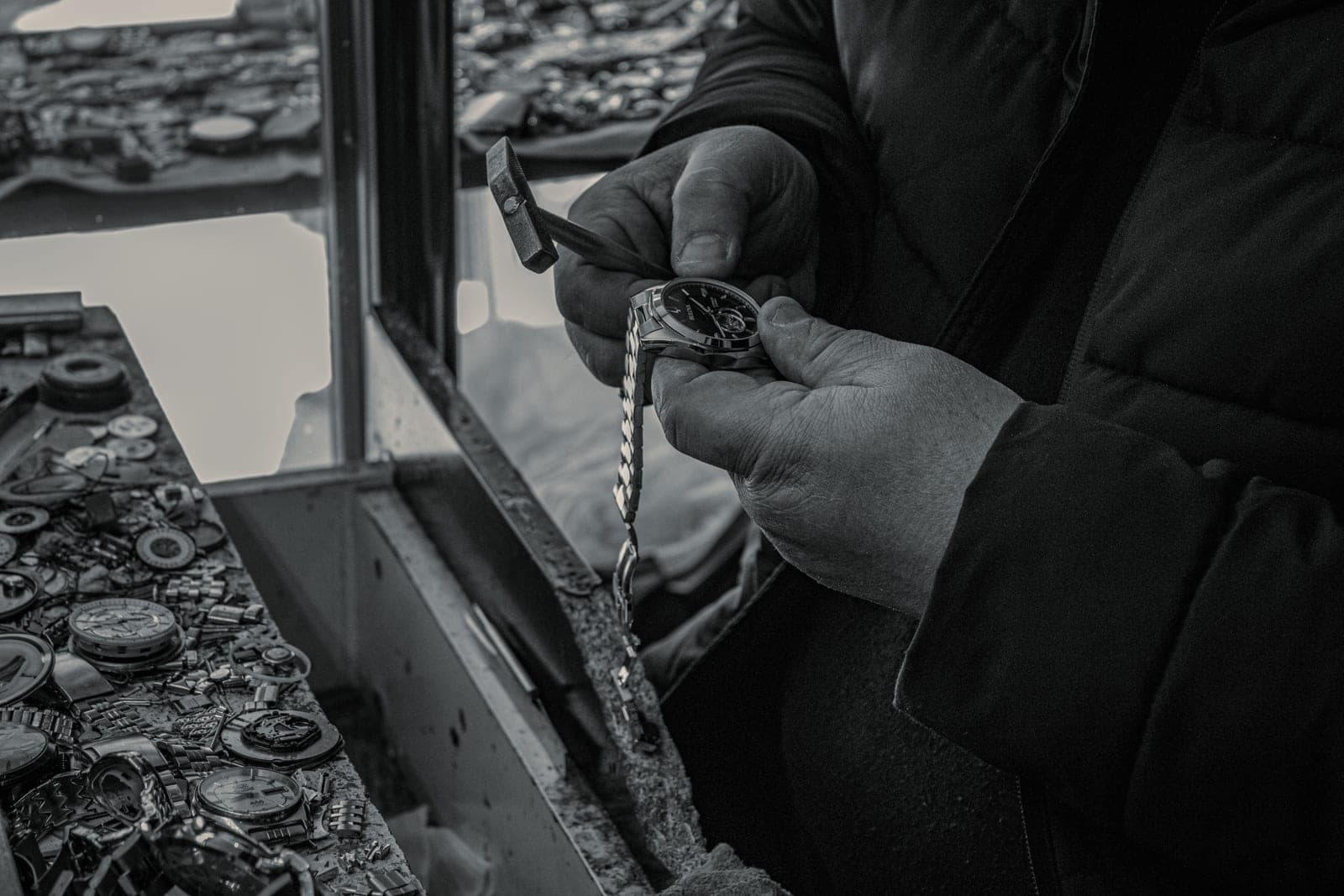
From Seiko's and Tissot's own descriptions, a complete service is:
- Full disassembly of the movement down to individual components.
- Ultrasonic cleaning of the movement, and of the case and bracelet.
- Replacement of worn parts — or, where warranted, replacement of the movement entirely.
- Fresh lubrication at every friction point. This is the actual reason for the interval: oils degrade whether or not the watch is worn.
- New gaskets and a water-resistance pressure test.
- Timing adjustment and accuracy testing back to the caliber's specification.
Seiko guarantees its work for twelve months. Tissot warrants each intervention for twenty-four. That difference is worth something and nobody advertises it.
The partial service, which almost nobody buys
Tissot charges $60 and Hamilton €60 for a partial service: gaskets, seals, a pressure test and a clean, without stripping the movement. It is the single highest-value thing you can do to a watch you intend to keep, and it is largely unknown.
The reason is that the most common way a healthy watch dies is water, not wear. A five-year-old 200m watch that has never had its gaskets replaced is not a 200m watch any more, and its owner has no way of knowing. $60 every few years fixes that for the entire life of the watch.
Manufacturer service or an independent?
| Manufacturer service center | Independent watchmaker | |
|---|---|---|
| Price | Published, at Seiko and Tissot | Usually lower, quoted per job |
| Parts | Genuine, guaranteed | Genuine for common calibers; harder for proprietary ones |
| Turnaround | Weeks — Citizen states 30-45 business days after approval | Often much faster |
| Warranty on the work | 12 months at Seiko, 24 at Tissot | Varies; ask before agreeing |
| Best for | In-warranty work, proprietary movements, anything unusual | 4R, NH and Miyota calibers, and any straightforward overhaul |
For the entry-level Japanese calibers that make up most of this site, a good independent is usually the better answer — those movements are their daily bread and the parts are commodity items. For a proprietary or in-warranty movement, go to the manufacturer.
When skipping a service is defensible
Most owners skip, and it is worth being honest about when that is a reasonable decision rather than simply neglect.
- On a cheap mechanical watch, arithmetically. A $176 overhaul on a $200 watch is hard to justify on price alone. It is justified if you want to keep *that* watch — which is a different and perfectly good reason.
- If the watch is keeping time and you never get it wet. The risk you are running is wear rather than water, and wear accumulates slowly.
- Never, if you swim in it. This is the case where skipping is not a saving. Gaskets age on a schedule of their own, and a failed seal turns a repairable watch into a corroded one.
The compromise almost nobody takes is the sensible one: skip the full overhaul, buy the $60 partial. You keep the water resistance, which is the thing that actually ends watches, and defer the expensive part until the watch tells you it needs it.
Signs it needs servicing now
- It has started losing or gaining much more than it used to. A sudden change in rate is the classic signal.
- The power reserve has dropped noticeably. A watch that used to run 40 hours off the wrist and now runs 20 has a mainspring or lubrication problem.
- Condensation under the crystal. Stop wearing it and get it seen immediately — this is water already inside.
- The rotor is noisy or gritty. Bearing wear.
- The crown feels rough or the winding is stiff. Often a cheap fix if caught, an expensive one if not.
Questions people actually ask
How much does it cost to service an automatic watch?
Seiko publishes $137 for a 7S, $176 for a 4R, $296 for a 6R and $373 for an 8R. Tissot publishes $210 for a complete service of a mechanical two- or three-hand watch. Hamilton publishes €230 in Europe. Citizen, Orient and Timex publish nothing.
How often do automatic watches need servicing?
Seiko recommends about every three years and is the only manufacturer here that publishes an interval. Hamilton states on its own service page that a precise frequency cannot be established because it depends on the model, environment and care.
What does a watch service include?
Full disassembly, ultrasonic cleaning of the movement, case and bracelet, replacement of worn parts, fresh lubrication, new gaskets, a water-resistance pressure test, and timing adjustment back to the caliber's specification.
Is a partial service worth it?
It is the best-value maintenance available. $60 at Tissot or €60 at Hamilton buys new gaskets and a pressure test, which addresses water ingress — the most common cause of death in an otherwise healthy watch.
Can I skip servicing my watch?
On a cheap mechanical watch you never get wet, arguably yes — the risk is gradual wear. If you swim in it, no: gaskets age regardless, and a failed seal turns a repairable watch into a corroded one.
Should I use the manufacturer or an independent watchmaker?
An independent for common calibers like Seiko's 4R and NH families or Miyota movements — they are routine work with commodity parts. The manufacturer for in-warranty repairs and proprietary movements.
Sources
Every specification and figure on this page came from one of these documents. Where a manufacturer does not publish something, the page says so rather than filling the gap.
- Seiko Service Center — estimated price for movement service and what it includes
- Seiko — why Seiko recommends servicing about every three years
- Tissot — service prices and the 24-month intervention warranty
- Hamilton — published service prices and maintenance frequency statement
- Citizen — five-year limited warranty
Read next
Best quartz watches
Seven quartz watches ranked, battery and solar, and the one to skip.
Seiko 4R vs 6R
Sapphire, 30 more hours and a published tolerance — against $120 more per overhaul.
What a watch actually costs to keep
Published service intervals and prices, computed over 10 and 20 years. The number nobody else publishes.

Best watch winders
Three winders compared on TPD, direction and power — and whether you need one.
How long do automatic watches last?
The limit is parts availability, not wear. What that means for which watch to buy.