No, and nothing at this price does. But Tissot publishes two documents that answer the question underneath that one, and both are more useful than any resale estimate.
No. A Tissot sells secondhand for well below what it cost new, like essentially every watch in this price range, because Tissot keeps making them and a used example has to undercut a new one with a warranty to be worth buying. What Tissot does give you is unusual transparency about the other side of the ledger: it publishes a complete US service price list — USD 210 for a complete service on a mechanical two or three-hand watch, USD 130 on a quartz one — and a 24-month warranty whose exclusions are written out in full. Over twenty years those published numbers will decide what the watch costs you far more than resale ever will.
This question almost always means something else. Very few people asking whether a Tissot holds its value are planning to sell one — they are asking whether spending Swiss-automatic money on a Tissot is a waste, and resale feels like the way to check.
It is not a good way to check, and at this price it is barely a question. The answer is no for the Tissot, no for the Seiko, no for the Hamilton and no for almost everything else this site covers. Depreciation at this tier is a supply problem, and the mechanics of it are the same for every brand.
What is worth doing instead is reading what Tissot publishes. There are two documents — a service price list and a warranty — and between them they answer the real question, which is what this watch will cost you between now and the day you stop wearing it. Both were read for this page on the date at the top, and both are linked at the foot of it.
How we picked
We have not worn these watches. What follows is what we checked instead, on documents you can open yourself — the same criteria, in the same order, on every roundup on this site. The full method is on the methodology page.
01Supply
Every watch on this page is currently listed for sale on Tissot's own store. A model you can still buy new, with a warranty, from an official dealer sets the ceiling on what a used one can fetch.
02What a service costs
Tissot publishes a full US price matrix by movement type and complication. Almost no brand at this level does, and it is the single most useful number for a watch you intend to keep.
03What the warranty covers
Twenty-four months from the date of purchase, for material and manufacturing defects present at delivery. Not for wear, not for accidents, and not for the battery.
04What voids it
Two things, both written into Tissot's own text: no dealer activation or stamp, and any work by someone Tissot has not authorized.
05Whether it can be rebuilt
Tissot's complete service is a full disassembly, clean, lubrication and parts replacement — or a complete movement replacement if required. Either way the watch comes back working, with 24 months on the work.
06What we will not do
Publish a resale figure. We have no verified source for secondhand prices, so there are none on this page or anywhere else on this site.
Disclosure · Some links below are Amazon affiliate links. If you buy through one we earn a commission at no extra cost to you. It does not decide what goes on this page or in what order — here is exactly how that works.
Quick picks
Ranked on the Keep Score below — six published specifications, weighted identically on every page. The last row is the one we would not buy.
#
Watch
Best for
Keep Score
Price
1
Tissot Gentleman Open Heart 40mm T127.407.11.041.01
Keep Score is arithmetic, not opinion — six published specifications, weighted the same way on every page. The formula is on our methodology page, so you can re-run it yourself.
01
Tissot Gentleman Open Heart 40mm T127.407.11.041.01
Best for: The Tissot with the best case for keeping
Sapphire over 100m with an 80-hour reserve and a Nivachron balance spring, which is Tissot's anti-magnetic alloy — a specification that stays current rather than one you grow out of.
The quick-release bracelet is the part that matters over years rather than weeks. Straps and bracelets are explicitly excluded from Tissot's warranty, so the ability to change one yourself, without a tool and without a service visit, is cover you do not have to claim.
An open dial is a taste, and tastes date faster than specifications. At 21mm the lug width is an odd size, which narrows the strap choices if you ever leave the bracelet behind.
The quick-release bracelet is the detail worth paying for: this is one of the few Swiss automatics at this level you can re-strap in thirty seconds without a tool.
Manufacturer specifications for the Tissot Gentleman Open Heart 40mm T127.407.11.041.01
This is the watch behind most of the questions this page exists to answer, and on the published numbers it holds up: a Powermatic 80 with an 80-hour reserve under sapphire, rated 100m, in a case under 11mm.
It is a mechanical two or three-hand watch, so it sits in the cheapest column of Tissot's service matrix at a published USD 210 for a complete overhaul with 24 months on the work.
The integrated bracelet is the catch. The 12mm figure is a case dimension rather than a strap size, so there is no changing the bracelet for something else — and the bracelet is one of the things the warranty does not cover.
Tissot publishes a US complete-service price of $210 for a mechanical two-or-three-hand watch, which makes this the most predictable Swiss automatic here to own. The 12mm lug width is not a strap size — the bracelet is part of the case.
Manufacturer specifications for the Tissot PRX Powermatic 80 40mm T137.407.11.041.00
Mechanically identical to the 40mm above — same Powermatic 80, same sapphire, same 100m rating, same position in Tissot's service matrix at a published USD 210.
A 35mm integrated-bracelet case is a genuinely different proposition on a smaller wrist, and it is the same purchase rather than a compromised version of it.
It carries the integrated bracelet too, so the strap limitation is identical. Our PRX 35 against 40 comparison covers which one fits on a smaller wrist.
An 80-hour Swiss automatic at 35mm with sapphire and 100m, backed by Tissot's published $210 service price. The integrated bracelet is the long-term trade — an 11mm fitting is not a strap size, so you keep the bracelet the watch came with or you keep nothing.
Manufacturer specifications for the Tissot PRX 35mm Powermatic 80 T137.207.11.041.00
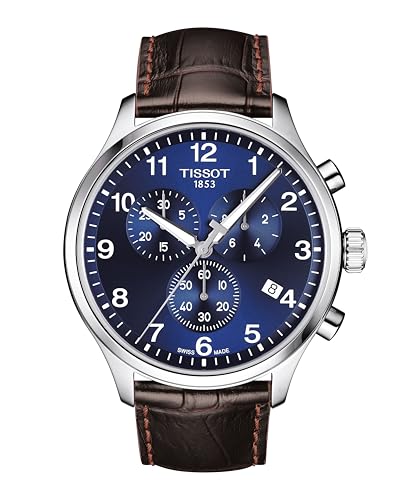
A quartz chronograph is the cheapest thing on this page to own over decades, and Tissot is unusual in publishing what one costs: USD 200 for a complete service against USD 310 for a mechanical chronograph.
PowerDrive returns the chronograph hands to zero electronically rather than through a column wheel, and the movement carries an end-of-life battery indicator, so the battery announces itself before it strands you.
It is 45mm across, which is a lot of watch, and Tissot's warranty specifically excludes battery life — the one consumable this watch is guaranteed to need.
Tissot publishes a US service price list, which almost no chronograph maker at this level does, and PowerDrive drives the hands back to zero electronically instead of through a column wheel. Cheap to keep, and 45mm across.
Manufacturer specifications for the Tissot Chrono XL Classic 45mm T116.617.11.047.01
Movement
Swiss quartz chronograph, PowerDrive, with end-of-life battery indicator
#adAffiliate link · We publish no price we have not verified today
The Le Locle is a genuinely good dress watch and this site rates it as one — under 10mm thick with an 80-hour reserve is a combination almost nothing else at this price manages.
It is the skip on this particular page because of what Tissot's own warranty says. The case is PVD-coated, and the warranty excludes the peeling of plating as normal aging; it is rated 30m, and water damage from ordinary wear is not a manufacturing defect either. The two things most likely to go wrong with this watch are the two Tissot has written out of the cover.
If you want a Tissot to keep rather than a Tissot to dress up in, the three above are rated 100m under sapphire with nothing plated to wear through.
Under 10mm thick with 80 hours of reserve is the combination that makes a dress watch practical — put it down on Friday and it is still running Monday. 30m means keep it off in the shower.
Manufacturer specifications for the Tissot Le Locle Powermatic 80 39.3mm T006.407.22.093.00
Movement
Swiss automatic, Powermatic 80, Nivachron balance spring
The short answer, and why it is the same for everyone
A watch holds value when supply is scarce against the demand for it. Nothing Tissot makes is scarce. Every model on this page is listed for sale on Tissot's own store today, which means anyone who wants one can buy a new example with a full warranty from an official dealer — so a used one has to be cheaper than that to be worth buying at all.
That is not a criticism of Tissot. It is the same arithmetic that applies to Seiko, Citizen, Orient and Hamilton, and it is why this site treats resale as the wrong axis for watches in this range. The brands that buck it do so by making fewer watches than people want, which is a different business from the one Tissot is in.
So the useful version of the question is not "what will I get back?" but "what will this cost me to keep?" — and that one has a published answer.
What Tissot publishes that almost nobody else does
Tissot prints a complete US service price list, broken down by movement type and by complication. For a watch you intend to own for twenty years this is worth more than any review, because it converts a vague future worry into a number you can plan around.
Tissot's published US service prices, read from its own service-prices page on the date at the top of this article. Tissot notes these are the rates applied by official Swatch Group service centers, that shipping is not included, and that agreed third-party service centers may charge differently.
Movement
Light
Partial
Complete
Quartz, 2-3 hands
USD 35
USD 60
USD 130
Quartz chronograph
USD 35
USD 70
USD 200
Mechanical, 2-3 hands
USD 35
USD 60
USD 210
Mechanical chronograph
USD 35
USD 70
USD 310
Touch-screen
USD 35
USD 75
USD 300
Tissot's published US service prices, read from its own service-prices page on the date at the top of this article. Tissot notes these are the rates applied by official Swatch Group service centers, that shipping is not included, and that agreed third-party service centers may charge differently.
The three tiers are not interchangeable and Tissot is specific about the difference. A light service is minor work at a minimum labor fee, with parts billed separately and — in Tissot's own words — no service warranty at all. A partial service cleans the case and bracelet, restores water resistance by replacing gaskets, and carries a two-year warranty on that water resistance. A complete service is a full disassembly, clean, lubrication and replacement of worn parts, or a complete movement replacement if required, and adds a two-year warranty on the movement on top.
That last point is the one worth sitting with. A Tissot does not become unrepairable; if the movement is beyond saving, the published complete-service price covers replacing it. There is no scenario in which the watch becomes landfill because a part is unobtainable, which is exactly the scenario that ends the life of most cheap watches.
Why the chronograph column costs more
A chronograph has more inside it, and Tissot prices accordingly: USD 310 to overhaul a mechanical chronograph against USD 210 for a mechanical two or three-hand watch, and USD 200 against USD 130 on the quartz side.
That gap is the strongest argument for buying a quartz chronograph rather than a mechanical one at this price, and it is the reason the Chrono XL sits where it does on this page. Over three overhauls the difference between the quartz chronograph and the mechanical one is larger than the price gap between them at the counter. Our chronograph page makes the same case at more length.
The warranty, and the two sentences that void it
Tissot warrants its watches for twenty-four months from the date of purchase against material and manufacturing defects existing at the time of delivery. If a repair cannot restore normal use, Tissot replaces the watch — and the replacement's warranty ends twenty-four months after the original purchase date, not from the date of the swap.
Two conditions sit around that, and both are easy to fall foul of without noticing.
The warranty only comes into force if a dealer activates it. Tissot's text is explicit: the cover applies only if the electronic warranty is activated by an official Tissot dealer, or failing that, the warranty certificate is dated, fully and correctly completed and stamped by one. A watch bought outside that channel may be perfectly genuine and still have no valid warranty attached to it.
Work by anyone Tissot has not authorized ends it. The warranty does not cover a watch handled by non-authorized persons — Tissot names battery replacement, services and repairs specifically — or one altered beyond its control. A cheap battery change at a mall kiosk can cost you the remainder of the cover.
Read from Tissot's own international warranty text, linked at the foot of this page.
Not covered
What Tissot says
The battery
"the life of the battery" — excluded outright
Normal wear and aging
A scratched crystal; alteration of the color or material of non-metallic straps such as leather, textile and rubber; peeling of the plating
Accidents
Knocks, dents, crushing and broken crystal, listed as damage from abnormal or abusive use, lack of care and negligence
Unauthorized handling
Any watch handled by non-authorized persons for battery replacement, service or repair, or altered beyond Tissot's control
An unactivated warranty
The cover only comes into force on dealer activation, or a certificate dated, completed and stamped by an official dealer
Read from Tissot's own international warranty text, linked at the foot of this page.
What this means if you are buying secondhand
The warranty conditions above are the reason a used Tissot is worth less than a new one by more than wear alone would explain, and they are worth understanding before you buy one rather than after.
A private-sale Tissot usually arrives with no activated warranty and no service history. That does not make it a bad buy — the published service price is the safety net, and a complete overhaul brings any Tissot back to working condition with 24 months on the work. It does mean the price should reflect that you are buying a watch with no cover and an unknown interior, and that the first thing you may need to budget for is the figure in the table above.
Buy from an official dealer and the position reverses: you get the activation, the stamp and the full twenty-four months. That difference is a real part of what the new price buys, and it is one of the few places where the new-versus-used calculation at this tier is not purely about condition.
How Tissot compares on the number that matters
Service transparency is one of the six things this site scores every watch on, and Tissot sits at the top of it alongside Seiko. The gap between a brand that publishes and one that does not is not a small detail — it is the difference between a known cost and an open-ended one.
Seiko's and Tissot's figures were read from their own service pages on the date at the top of this article. The three brands marked none published have no US service price list we have been able to find.
Brand
Published service price
Warranty
Seiko
$176 for a 4R, $296 for a 6R
3 years
Tissot
USD 130 to USD 310, by movement and complication
2 years
Citizen
None published
5 years, movement only
Orient
None published
3 years
Timex
None published
1 year
Seiko's and Tissot's figures were read from their own service pages on the date at the top of this article. The three brands marked none published have no US service price list we have been able to find.
Citizen's five years is the longest cover on this site and genuinely valuable — what those five years actually include is a page of its own. But Citizen publishes no service price, so what happens in year six is unknowable today. Tissot's two years is shorter and its published rates make the next twenty years legible.
What we will not tell you
On prices: the service figures on this page are Tissot's own published US rates, read from its service-prices page on the date above. We publish no secondhand or resale figures anywhere on this site, because we have no source for them we would be willing to cite. Watch prices come from the price layer, not from this text.
You will find pages elsewhere quoting what a used PRX or Le Locle fetches. We have no verified source for secondhand prices — no auction data, no dealer feed, nothing we could cite — and this site does not print figures it cannot stand behind. So there are no resale numbers here, and the absence is deliberate rather than an oversight.
What we can tell you is the part that is written down: what Tissot charges to service a watch, what its warranty covers, and what ends it. Those are the numbers that will actually leave your account. The cost of ownership page runs the full arithmetic across every brand here.
Questions people actually ask
Do Tissot watches hold their value?+
No, not in the sense people usually mean. A Tissot sells secondhand for well below its new price, because Tissot still makes the model and a used example has to undercut a new one with a warranty. That is true of almost every watch at this price, not a Tissot problem.
Are Tissot watches worth anything secondhand?+
They retain some value, but we publish no figures because we have no source for secondhand prices we would be willing to cite. What we can say is that a used Tissot with no activated warranty and no service history should be priced to reflect both, and that Tissot's published complete-service price is what it costs to put the second one right.
What does a Tissot service cost?+
Tissot publishes US rates by movement type. A complete service is USD 130 for a quartz two or three-hand watch, USD 200 for a quartz chronograph, USD 210 for a mechanical two or three-hand watch and USD 310 for a mechanical chronograph. A light service is USD 35 and a partial is USD 60 to USD 75.
How long is the Tissot warranty?+
Twenty-four months from the date of purchase, covering material and manufacturing defects present at delivery. It excludes the battery, normal wear and aging, accidental damage, and any watch worked on by someone Tissot has not authorized.
Does having a Tissot serviced elsewhere void the warranty?+
Yes, within the warranty period. Tissot's text excludes watches handled by non-authorized persons, naming battery replacement, services and repairs. After the twenty-four months there is nothing left to void.
Is a Tissot a good investment?+
No, and neither is anything else in this price range. Buy one because you want to wear it for twenty years. The recurring cost of servicing it will matter far more to what it really costs you than any resale figure would.
Which Tissot is cheapest to own long term?+
The quartz chronograph, on Tissot's own numbers: USD 200 for a complete service against USD 310 for the mechanical equivalent, and no winding or regulation in between. The trade is that a quartz movement is not the thing most people want from a Swiss watch.
Sources
Every specification and figure on this page came from one of these documents. Where a manufacturer does not publish something, the page says so rather than filling the gap.