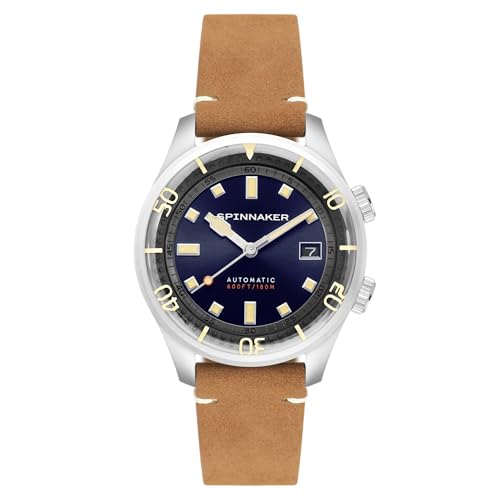
Same crystal, same 22mm lugs, same screw-down crown, same bracket. The whole decision is 50m of water resistance, one year of warranty, and whose caliber your watchmaker has already seen.
Buy the Orient Kamasu. It scores 9.0 against the Fleuss's 8.0 on 200m rather than 150m, three years of warranty rather than two, and an in-house hacking caliber. Buy the Spinnaker Fleuss if your wrist is large — its published 51mm lug-to-lug is the longest on this site — or if a commodity Miyota matters more to you than depth.
Disclosure · Some links below are Amazon affiliate links. If you buy through one we earn a commission at no extra cost to you. It does not decide what goes on this page or in what order — here is exactly how that works.
Top pick
Orient Kamasu RA-AA0004E39B
Best for: The one to buy, on every specification except footprint
9.0/10
Keep Score
41.8mm, 46.8mm lug-to-lug, 12.8mm, sapphire, 200m, 22mm lugs, three years.
This is the highest-scoring watch on this site with a live Amazon listing, at 9.0, and the reasons are all ownership reasons. Sapphire and 200m with a screw-down crown is a genuine diver's specification, and Orient's three-year warranty is longer than the two years Tissot and Hamilton give you on watches that cost several times more.
The verdict first: buy the Orient Kamasu. It takes 9.0 out of 10 on this site's scale against the Spinnaker Fleuss's 8.0, and that full point is built from three things — 200m of water resistance instead of 150m, a three-year warranty instead of two, and an in-house caliber that hacks and hand-winds. None of it is visible in a photograph, which is exactly why the comparison is worth writing down.
Buy the Spinnaker Fleuss in one case, and it is a real one: a large wrist. Spinnaker publishes a 51mm lug-to-lug, the longest figure on this site, against the Kamasu's 46.8mm. That is more than four millimeters of extra footprint, which on a wrist over about 185mm is the difference between a watch that fits and a watch that looks borrowed.
What makes these two genuinely cross-shoppable is how much they share. Both are steel automatic divers with a sapphire crystal, a screw-down crown, a unidirectional bezel and a standard, even 22mm lug width, in the same price bracket. At this level sapphire is normally the thing you give up — Seiko still fits Hardlex to the 5 Sports line — so two sapphire divers at this money is a straight fight rather than a mismatch.
Side by side
Every figure read from the manufacturer's own product page, linked under each pick below.
Orient Kamasu RA-AA0004E39B
Spinnaker Fleuss SP-5055
Diameter
41.8mm
43mm
Lug-to-lug
46.8mm
51mm
Thickness
12.8mm
13mm
Lug width
22mm standard
22mm standard
Case
Stainless steel
316L stainless steel
Crystal
Sapphire
Sapphire
Water resistance
200m
150m
Crown
Screw-down
Screw-down
Movement
Orient F6922, in-house, hacking and hand-winding
Miyota 8215, 21 jewels, 21,600 vph
Power reserve
40 hours
42 hours
Warranty
3 years
2 years
Published US service price
None
None
Keep Score
9.0
8.0
Every figure read from the manufacturer's own product page, linked under each pick below.
On prices: every buy button on this page reads its figure from the live price layer and stamps the date it was checked, or else reads "Check price on Amazon". No price is written into this text. Service figures quoted here are the manufacturers' own published rates.
How we picked
We have not worn these watches. What follows is what we checked instead, on documents you can open yourself — the same criteria, in the same order, on every roundup on this site. The full method is on the methodology page.
01Crystal
Sapphire on both, and it is the reason this is a fair fight at this money.
02Water resistance
200m against 150m, read from each maker's own document. Both have a screw-down crown.
03Footprint
Both makers publish a lug-to-lug, which is rare. 46.8mm against 51mm — the widest gap of any pair we have compared.
04Caliber
An in-house Orient F6922 that hacks and hand-winds, against a Miyota 8215 that every independent watchmaker has already serviced.
05Warranty and service
Three years against two. Neither maker publishes a US service price list, so the caliber is what decides your repair options.
Quick picks
Ranked on the Keep Score below — six published specifications, weighted identically on every page. The last row is the one we would not buy.
#
Watch
Best for
Keep Score
Price
1
Orient Kamasu RA-AA0004E39B
41.8mm, 46.8mm lug-to-lug, 12.8mm, sapphire, 200m, 22mm lugs, three years.
The one to buy, on every specification except footprint
Prices as of October 19, 2026. Amazon pricing changes without notice — the figure on the listing is the one that counts.
Keep Score is arithmetic, not opinion — six published specifications, weighted the same way on every page. The formula is on our methodology page, so you can re-run it yourself.
01
Orient Kamasu RA-AA0004E39B
Best for: The one to buy, on every specification except footprint
This is the highest-scoring watch on this site with a live Amazon listing, at 9.0, and the reasons are all ownership reasons. Sapphire and 200m with a screw-down crown is a genuine diver's specification, and Orient's three-year warranty is longer than the two years Tissot and Hamilton give you on watches that cost several times more.
The F6922 is an in-house Orient caliber that both hacks and hand-winds — you can stop the seconds to set it accurately and wind it without shaking it awake. At this price that combination is not standard; plenty of cheaper automatics do neither.
A published 46.8mm lug-to-lug on a 41.8mm case is a shorter footprint than the diameter suggests, and the 22mm lug width is standard and even, so straps are cheap and permanently available. If you are between the two watches on this page and your wrist is average or small, the decision is made here.
The honest cost: Orient publishes no US service price list, so you cannot find out what an overhaul costs before you buy. The caliber is in-house, which means parts run through Orient rather than through the generic supply chain the Fleuss's Miyota sits in. That gap is worth 0.6 of a point in our formula and it is the one thing the Spinnaker genuinely answers better.
On paper this is the best value in the category and it is not close: sapphire and a hacking, hand-windable in-house caliber at a price where Seiko still fits Hardlex. Orient's three-year warranty is longer than Hamilton's or Tissot's.
Manufacturer specifications for the Orient Kamasu RA-AA0004E39B
51mm of published lug-to-lug is the longest figure on this site by a clear margin, and it is the reason to buy this one. On a wrist over about 185mm the Kamasu's 46.8mm reads small; this does not. Spinnaker publishing the number at all puts it ahead of most of the category, where the figure is simply left off.
The Miyota 8215 is the other argument. It is one of the most widely produced automatic calibers in the world, which means any independent watchmaker has already serviced one and parts are a commodity rather than a brand relationship. Against an in-house movement, that is a real long-term advantage even though neither maker publishes a service price.
Sapphire, a screw-down crown, 15 ATM and a stated two-year warranty on a 316L case, at a price below the Kamasu. The specification-per-dollar here is excellent and it is why this scores 8.0 rather than something lower.
The costs are the three lines that make up the gap. 150m instead of 200m — fine for swimming, short of a diver's rating. Two years of warranty instead of three. And Spinnaker, like Orient, publishes no service pricing, but unlike Orient it also sits outside any manufacturer service network, so an independent is not a fallback, it is the plan.
Sapphire, 15 ATM, a screw-down crown and a stated two-year warranty on a Miyota 8215 — a caliber every independent has seen. Then Spinnaker publishes the lug-to-lug: 51mm, the longest on this site by a clear margin.
Manufacturer specifications for the Spinnaker Fleuss Automatic SP-5055
Worth naming because a lot of people shopping this bracket do not actually want a mechanical watch — they want a tough diver that is right when they pick it up. This is that: a 200m Promaster Diver that runs on light, so there is no winding, no battery change and no setting after a fortnight in a drawer.
Citizen's five-year limited warranty is the longest term of any brand on this site, and the 20mm lug width is standard.
Two real costs against the two watches above. The crystal is mineral, not sapphire, so it will collect scratches that cannot be polished out — on a diver that gets knocked about, that is the specification you will see every day. And an Eco-Drive module is replaced rather than rebuilt, where both mechanical watches here can be stripped and returned to spec indefinitely. It scores 6.8.
Citizen also publishes no lug-to-lug and no thickness for this reference, so on a 44mm case you cannot check the footprint before ordering.
Identical to the BN0150 in every specification Citizen publishes. Choose on the dial, and on nothing else.
Manufacturer specifications for the Citizen Promaster Diver BN0151-09L
Movement
Citizen E168 Eco-Drive, light-powered
Power reserve
Not published
Case
44mm stainless steel
Lug-to-lug
Not published
Thickness
Not published
Lug width
20mm
Crystal
mineral
Water resistance
200m
Warranty
5 years
Citizen's five-year limited warranty excludes the power cell, case, bracelet and strap.
The Seiko 5 Sports is the watch most people are told to buy instead of either of these, and on this page it is the one to be careful with. It is a good watch — it scores 8.0, level with the Fleuss — but read where that score comes from before you treat it as a tie.
The Seiko earns its 8.0 on service transparency: Seiko publishes a flat $176 to overhaul the 4R36 and operates a US service network, which is worth a full point where Orient scores 0.4 and Spinnaker 0.2. What it does not have is the specification. The crystal is Hardlex, not sapphire — harder than ordinary mineral, softer than sapphire, and unlike acrylic it cannot be polished out when it marks. The rating is 100m rather than 150m or 200m.
So the honest framing is this: buy the Seiko if you are buying the service network and the published price, which is a legitimate reason. Do not buy it believing it is the safe middle ground between these two on specification, because on crystal and water resistance it is behind both.
Its 46mm published lug-to-lug on a 42.5mm case is the shortest footprint of the four watches here, which does make it the best of them for a small wrist.
The 4R36 is the most commonly serviced mechanical caliber in the United States and Seiko publishes a flat $176 price to overhaul it. That single fact does more for a twenty-year horizon than any spec on the case.
Manufacturer specifications for the Seiko 5 Sports SRPD55
Movement
Seiko 4R36, automatic with manual winding, 24 jewels
Our Keep Score reads six published specifications, and on three of them these two watches are identical: sapphire takes the full 2.5, a rebuildable mechanical movement takes the full 2.5, and a standard even 22mm lug width takes the full 1.0. The entire difference between 9.0 and 8.0 sits in the other three lines.
Why a watch that looks like a draw is not one.
Scored line
Kamasu
Fleuss
Difference
Water resistance
200m — 1.5 of 1.5
150m — 1.1 of 1.5
0.4 to Orient
Warranty
3 years — 1.05 of 1.5
2 years — 0.7 of 1.5
0.35 to Orient
Service transparency
0.4 of 1.0
0.2 of 1.0
0.2 to Orient
Crystal, movement, strap standard
Full marks
Full marks
Tied
Why a watch that looks like a draw is not one.
That is worth sitting with, because none of those three lines shows up in a product photograph and all three show up in what the watch costs you over twenty years. It is the same argument our cost of ownership page makes across the whole site.
200m against 150m, honestly
Both watches have a screw-down crown, and both will survive swimming, showering and rain without complaint. The difference is not that 150m fails where 200m succeeds in ordinary use — it almost never does. The difference is what the rating signals about how the case was built and tested, and that 200m is the threshold at which our formula stops deducting.
If you want the full version of what each rating actually permits, water resistance explained sets it out, including the part most guides skip: the rating describes a static pressure test, not a depth you should swim to. For a watch you will take in a pool and forget about, either of these is enough. For a watch that will go in the sea regularly, take the 200m.
An in-house caliber or a commodity one
This is the most interesting trade on the page, and it runs against the grain of the usual advice. "In-house" is normally treated as the premium answer, and on the Kamasu it genuinely buys something: hacking and hand-winding at a price where neither is guaranteed, from a caliber Orient makes in volume for its own watches.
But neither Orient nor Spinnaker publishes a US service price list, so for both watches the realistic repair route is an independent watchmaker rather than a brand service center. And on that route a Miyota 8215 is the easier watch to own: it is one of the most widely produced automatic movements in existence, every independent has worked on one, and parts are generic rather than brand-controlled. Our Miyota against Seiko movements guide covers what that supply chain actually looks like.
Our formula still gives Orient the edge — 0.4 against 0.2 — because Orient is a manufacturer with a service operation and Spinnaker is not. But if your mental model is "whatever happens, someone local can fix it," the Fleuss is the stronger answer, and that is a defensible way to buy a watch.
Fit is the one place the Fleuss wins outright
Both makers publish a lug-to-lug, which is rarer than it should be — Citizen publishes none for the Promaster Diver above, and Hamilton publishes none for either of its 42mm field watches. So this is a pair you can actually choose between on fit rather than on hope.
46.8mm against 51mm is the widest footprint gap between any two watches we have compared on this site. Under about a 165mm wrist, the Kamasu is the only sensible one of the two. Between 165mm and 185mm both will sit properly. Over about 185mm the Fleuss is the one that will not read small, and it is a pick on our watches for large wrists page for exactly that reason. Best watches for small wrists runs the same measurement from the other end.
Thickness is close enough to ignore: 12.8mm against 13mm. Both are chunky in the way dive watches are, and neither will slide under a tight cuff.
Where each one sits in the category
The Kamasu is the default answer on our best dive watches under $500 page and has been since launch, on the same reasoning this page reaches. The Fleuss is a microbrand pick — best microbrand dive watches puts it in the context of Baltic and BOLDR, and Fleuss against Bradner compares it with Spinnaker's thicker, deeper-rated alternative.
If this comparison has you questioning the microbrand route generally, microbrands against Seiko is the category-level version of the same argument: more specification per dollar on one side, a named caliber with a published service price on the other.
How to choose
Buy the Kamasu if your wrist is average or small, if you want a 200m rating, or if three years of warranty and an in-house hacking caliber are what you are paying for.
Buy the Fleuss if your wrist is over about 185mm, if you want the longest published footprint on this site, or if you would rather own a caliber any independent can service.
Buy the Citizen Promaster Diver if you do not actually want a mechanical watch — 200m, five years of warranty and nothing to wind, at the cost of a mineral crystal.
Do not default to the Seiko 5 on the assumption that it splits the difference. It is behind both on crystal and water resistance; what it buys you is a published $176 overhaul and a service network.
Questions people actually ask
Orient Kamasu or Spinnaker Fleuss?+
The Kamasu for most buyers: 200m against 150m, three years of warranty against two, and an in-house caliber that hacks and hand-winds, for 9.0 against 8.0. The Fleuss if your wrist is large — its published 51mm lug-to-lug is the longest on this site — or if a commodity Miyota caliber matters more to you than depth rating.
Do both have a sapphire crystal?+
Yes, and that is what makes this a fair comparison. Both fit sapphire at a price where Seiko still fits Hardlex to the 5 Sports line. Sapphire takes full marks on both in our scoring.
Which one is bigger?+
The Fleuss, and by more than the diameters suggest. It is 43mm against 41.8mm, but 51mm across the lugs against 46.8mm — a four-millimeter footprint difference, which is what actually decides fit.
Is the Miyota 8215 a downgrade from an in-house Orient movement?+
Not straightforwardly. The Orient F6922 hacks and hand-winds and the 8215 is the plainer caliber, so on features the Orient wins. On serviceability the Miyota is arguably easier to live with: it is one of the most widely produced automatics in the world, so any independent has seen one and parts are generic.
Can you dive with the Spinnaker Fleuss?+
It is rated 150m with a screw-down crown, which covers swimming and snorkeling comfortably. The Kamasu's 200m is the rating we would want for regular sea use, and it is the threshold our formula stops deducting at.
What does a service cost on either?+
Neither Orient nor Spinnaker publishes a US service price list, which is why both lose points on that line. For comparison, Seiko publishes $176 for a 4R overhaul and Tissot $210 for a complete mechanical service — on both watches here, expect to be quoted after inspection by an independent.
Which has the better warranty?+
Orient, at three years against Spinnaker's stated two-year international warranty. Three years is also longer than the two years Hamilton and Tissot give on much more expensive watches.
Should I just buy a Seiko 5 Sports instead?+
Only if what you want is the service network. The Seiko scores 8.0 — level with the Fleuss — but it gets there on Seiko's published $176 overhaul price, not on specification: it has Hardlex rather than sapphire and 100m rather than 150m or 200m.
Sources
Every specification and figure on this page came from one of these documents. Where a manufacturer does not publish something, the page says so rather than filling the gap.