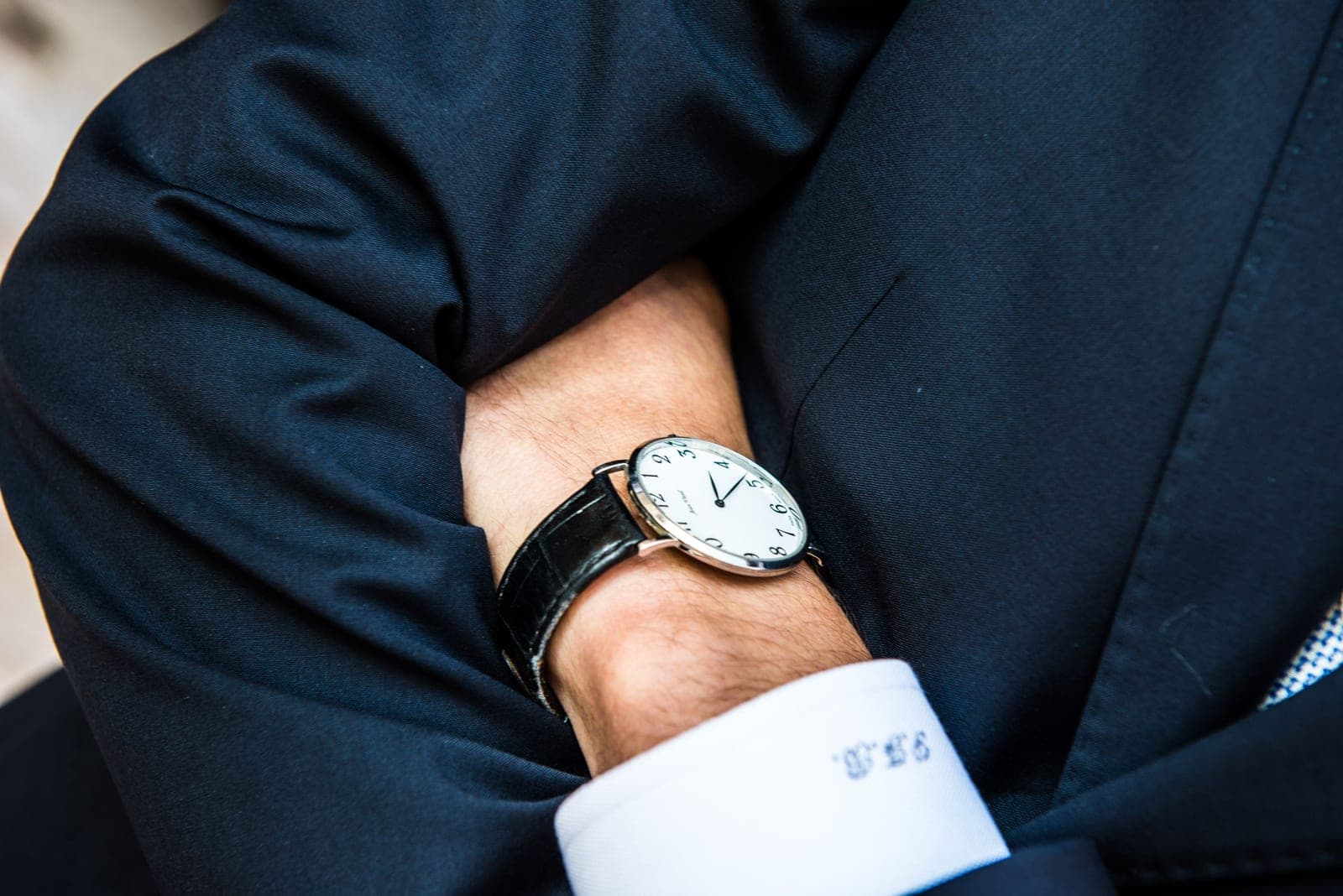
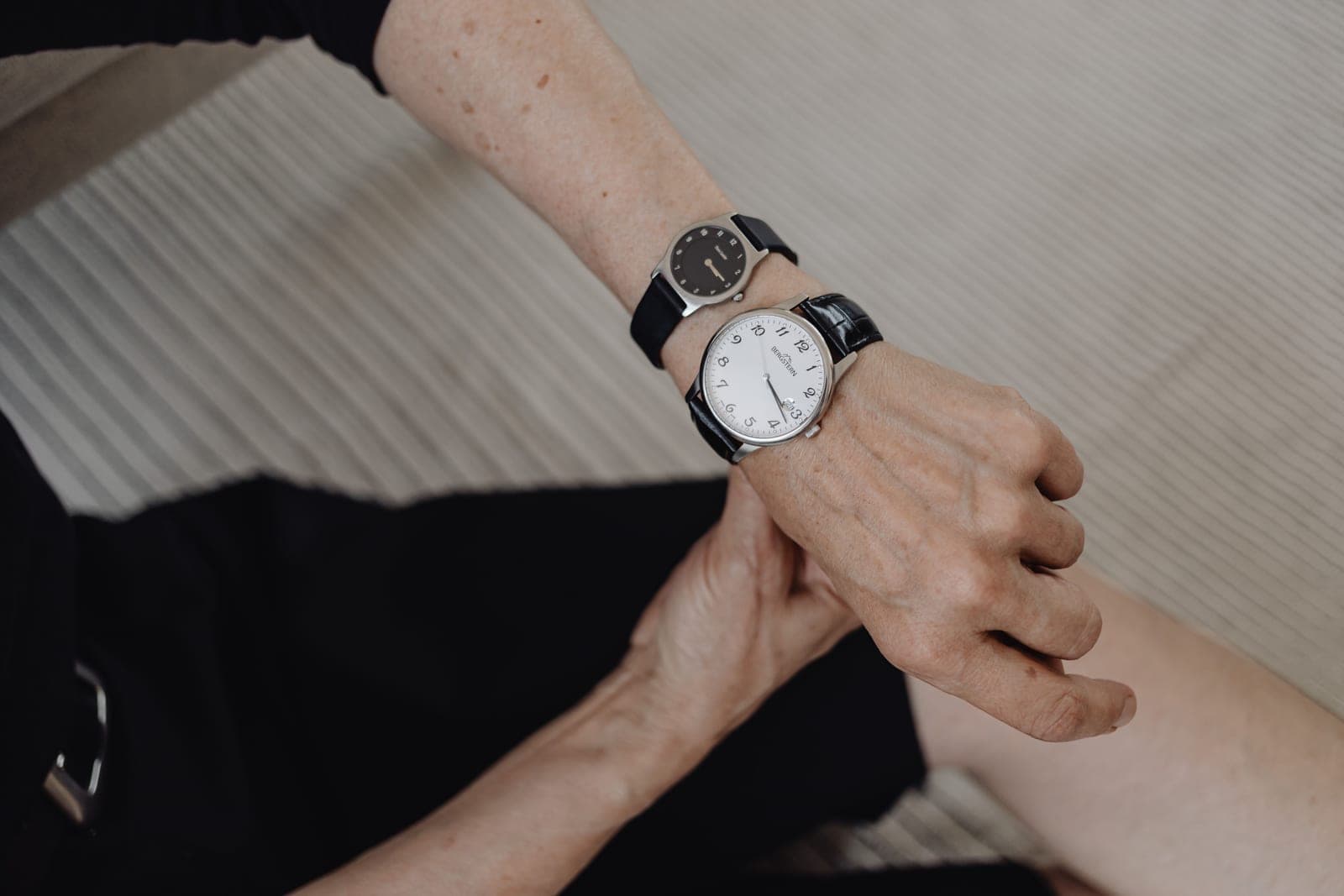
One of these shows you the phase of the moon, the day, the month and the date. The other shows you the time and can be rebuilt for as long as you own it. That is the whole decision.
Buy the Timex Marlin Moon Phase if you want a dial that does something and a watch you can wear in the rain: four sub-dials, a 50m rating and a coin-cell battery. Buy the Orient Bambino Version 7 if you intend to keep it — a named in-house automatic, three years of warranty, 6.3 against 5.6.
Disclosure · Some links below are Amazon affiliate links. If you buy through one we earn a commission at no extra cost to you. It does not decide what goes on this page or in what order — here is exactly how that works.
Top pick
Timex Marlin Moon Phase 40mm TW2W51300
Best for: If you want the complication and the better water rating
Four sub-dials for the price of a plain watch. Timex runs the lunar display alongside a real calendar — day of the week, month and date — on a 40mm polished stainless case, 12mm tall, on a fold-over-clasp steel bracelet. It publishes a watch weight of 108.14 grams, a Markers (Full) blue dial and a 20mm band width, which is more dimensional detail than it gives on either of its mechanical Marlins.
Buy the Timex Marlin Moon Phase if what you want is a dial that does something. Four sub-dials — the lunar cycle, the day, the month and the date — in a 40mm polished steel case under a domed acrylic crystal, rated to 50m, running on a commodity coin cell. Buy the Orient Bambino Version 7 if you intend to still own it in fifteen years: a named in-house automatic that hacks and hand-winds, 38.4mm across with a published 44mm lug-to-lug, and three years of warranty against one.
This is the third Marlin-against-Bambino question this site has been asked and it is the only one that is not a mechanical-against-mechanical argument. The Marlin Automatic against the Bambino is a question about movement disclosure; the hand-wound 34mm against the Bambino 38 is a question about footprint and winding. This one is a question about what a watch is for, because one of these two is a quartz multifunction and the other is a machine.
Decide the complication question first
Almost everybody arriving at this comparison has already fallen for the Moon Phase dial, and it is worth saying plainly that this is a legitimate reason to buy a watch. A lunar display is pure ornament — nobody needs to know the phase of the moon — and it is also the single most charming thing you can get on a wrist for this money. Timex describes the sub-dial as mirroring the lunar cycle, and the other three registers are a genuine calendar: day, month, date.
The Bambino does none of that. It is three hands and a date window on a domed dial, which is the most conservative thing in watchmaking and the reason it has sold for years. If the moon phase is what drew you here, the Bambino will not replace it and no amount of movement documentation changes that. If you are indifferent to the sub-dials, stop reading and buy the Bambino — the rest of this page is about what the complication costs you.
On prices: we publish no figure we have not verified today. Both of these sit in the same sub-$300 bracket and they move around inside it, so every price in the table above is read from the live price layer when this page loads and carries the date it was checked. Where there is no fresh figure the button reads "Check Price on Amazon".
How we picked
We have not worn these watches. What follows is what we checked instead, on documents you can open yourself — the same criteria, in the same order, on every roundup on this site. The full method is on the methodology page.
01What the dial actually tells you
The Timex runs four sub-dials: the phase of the moon, the day of the week, the month and the date. The Orient gives you three hands and a date window. Neither is better; they are different reasons to own a watch.
02What happens in year ten
A mechanical movement can be stripped, cleaned, lubricated and returned to specification indefinitely. A quartz multifunction module is replaced, not rebuilt, and only for as long as the part is made. This is the line the whole page turns on.
03Water resistance
50m against 30m, and the Timex is the one that wins it. Timex rates this watch for light swimming and showering; Orient rates the Bambino at 30m, which is rain and handwashing.
04Crystal
Acrylic against domed mineral. Acrylic scratches from almost anything and polishes out at a kitchen table; mineral resists more and then keeps every mark permanently.
05Fit, on the numbers each maker publishes
40mm and 12mm thick with no lug-to-lug published, against 38.4mm and 12.5mm with a published 44mm lug-to-lug. One of those you can check before buying.
06What keeping it costs
Timex publishes the battery type — SR621SW, a coin cell any shop stocks. Orient publishes no US service price for the F6724. Both answers are incomplete, and they are incomplete in opposite directions.
Quick picks
Ranked on the Keep Score below — six published specifications, weighted identically on every page. The last row is the one we would not buy.
Prices as of November 9, 2026. Amazon pricing changes without notice — the figure on the listing is the one that counts.
Keep Score is arithmetic, not opinion — six published specifications, weighted the same way on every page. The formula is on our methodology page, so you can re-run it yourself.
01
Timex Marlin Moon Phase 40mm TW2W51300
Best for: If you want the complication and the better water rating
Four sub-dials for the price of a plain watch. Timex runs the lunar display alongside a real calendar — day of the week, month and date — on a 40mm polished stainless case, 12mm tall, on a fold-over-clasp steel bracelet. It publishes a watch weight of 108.14 grams, a Markers (Full) blue dial and a 20mm band width, which is more dimensional detail than it gives on either of its mechanical Marlins.
It also wins the specification that matters most in ordinary life, and this is the surprise of the comparison: Timex rates it to 50m and states it is suitable for light swimming or showering, while the Bambino is a 30m watch. Neither should go near a pool deck, but only one of them survives being forgotten in the shower.
The acrylic crystal is a feature at this price rather than a saving. It will pick up scratches from a doorframe and every one of them comes out at home with a cloth and a little polishing paste. The domed profile is also what makes the case read as a 1960s watch rather than a 2020s one.
Against it: nothing inside can be rebuilt. Timex publishes no caliber, no jewel count and no power reserve for this reference — we checked the product page row by row — so the module is unnamed and, when it eventually fails, replaced rather than serviced. The warranty is one year for defects in materials and workmanship. Timex publishes no lug-to-lug, so 40mm is the only size figure you get. And a dead coin cell means resetting four indications rather than one.
Timex publishes the battery — SR621SW, a coin cell any shop stocks — which is more than it publishes about the caliber in its mechanical Marlins. That is the trade here in one line: nothing inside can be rebuilt, and nothing inside is expensive to keep running either.
Manufacturer specifications for the Timex Marlin Moon Phase 40mm TW2W51300
Movement
Quartz analog multifunction, with moon phase, day, month and date sub-dials (module not named by Timex)
Power reserve
Not applicable
Case
40mm stainless steel
Lug-to-lug
Not published
Thickness
12mm
Lug width
20mm
Crystal
acrylic
Water resistance
50m
Warranty
1 year
Timex states a one-year limited manufacturer's warranty covering defects in materials and workmanship on this product page.
Orient names the movement — the in-house F6724 — and states that it hacks and hand-winds, so it can be set to the second and wound without being shaken, with 40 hours of reserve. It is a current caliber from a company owned by Seiko Epson, which means an independent watchmaker can identify it and quote the work before opening the case. That single fact is what puts it at 6.3 on our published formula against the Timex's 5.6.
Three years of warranty against one, and Orient publishes a 44mm lug-to-lug on a 38.4mm case — unusually honest and the most useful number on this page, because it is the figure that decides whether a watch overhangs a wrist. On a narrow wrist this is the only one of the two you can buy with any confidence.
Who it is for: somebody who wants one dress watch, wants it to outlast them, and is content with three hands and a date. Who should skip it: anybody who came here for the moon phase, and anybody who will get it wet.
Against it: the domed mineral crystal is the compromise Orient never fixes on this line, and it keeps every mark it collects. 30m is rain and handwashing, full stop. And Orient publishes no US service price, so the eventual overhaul is a quote — just a quote on a movement somebody can name.
A 44mm lug-to-lug is genuinely small by modern standards, and this is the Bambino to buy if the 40.5mm versions never sat right. The domed mineral crystal is the compromise, and it is the one Orient never fixes on this line.
Manufacturer specifications for the Orient Bambino Version 7 RA-AC0M03S30B
We earn nothing on this link. Timex sells it directly.
The third answer, and the one people in this comparison most often end up at. The Marlin Automatic is the same 40mm mid-century case and the same domed acrylic crystal as the Moon Phase, with a mechanical movement instead of a battery — so it keeps the look and the 50m rating while putting a rebuildable machine inside.
What you give up is the dial. No moon phase, no day, no month: a plain two-hand-and-seconds layout with a date. If the complication was the point, this is not the escape route.
Who it is for: a reader who wants the Marlin case and a movement with a future. Who should skip it: anybody who needs to buy it on Amazon today — Amazon does not carry this reference, so the link below goes straight to Timex and we earn nothing on it.
Against it: it is 13mm tall against the Moon Phase's 12mm, Timex publishes no lug-to-lug for it either, and the warranty is the same single year. Our full write-up is on the Marlin Automatic against the Bambino, linked below.
Acrylic reads as a downgrade and mostly is not: it scratches easily and polishes out with a cloth and a tube of paste, which sapphire does not. On a watch you intend to keep for decades, that is a feature.
Manufacturer specifications for the Timex Marlin Automatic 40mm TW2V44600
Movement
Automatic (caliber not published by Timex)
Power reserve
Not published
Case
40mm stainless steel
Lug-to-lug
Not published
Thickness
13mm
Lug width
20mm
Crystal
acrylic
Water resistance
50m
Warranty
1 year
Timex's one-year warranty explicitly excludes the crystal, strap, case and battery.
Read from Timex's and Orient Watch USA's own product pages on 8 November 2026. "Not published" means the maker states no figure — we do not estimate one.
Timex Marlin Moon Phase TW2W51300
Orient Bambino Version 7
Movement
Quartz analog multifunction; module not named
Orient F6724 in-house automatic, hacking and hand-winding
Power reserve
Not applicable; battery type SR621SW
40 hours
What the dial shows
Moon phase, day, month, date
Hours, minutes, seconds, date
Case
40mm, 12mm thick, polished
38.4mm, 12.5mm thick
Lug-to-lug
Not published
44mm
Weight
108.14g, stated
Not published
Crystal
Acrylic, domed
Mineral, domed
Water resistance
50m
30m
Lug width
20mm
20mm
Band
Stainless steel bracelet, fold-over clasp
Leather strap
Warranty
1 year, materials and workmanship
3 years
Published US service price
None
None
Keep Score
5.6
6.3
Read from Timex's and Orient Watch USA's own product pages on 8 November 2026. "Not published" means the maker states no figure — we do not estimate one.
Four sub-dials, and what they ask of you
A multifunction quartz watch keeps four displays in step with a single battery, and that is a genuinely clever thing for the money. It is also four things to put right rather than one. When the cell dies — and Timex publishes the type, SR621SW, which is the useful half of the story — you are not setting the time and walking away. You are setting the time, the date, the day of the week, the month and the lunar display, and the moon is the fiddly one because you have to know where in the cycle you actually are.
Timex does not publish a correction interval for the lunar sub-dial and we are not going to invent one. What we can say is structural: a mechanical or quartz moon phase display approximates a lunar month with a fixed set of teeth or steps, so it drifts, and it is the owner's job to nudge it back. If you enjoy that, it is part of the appeal. If you were hoping for a watch you set once, this is not it.
The Bambino asks almost nothing. Wear it and it winds itself; leave it for two days and it stops, and restarting it is a wind and one date correction. Our page on hand-wound against automatic covers that routine in full.
The water line is the one the Timex wins
This is the result nobody expects, and it is worth being clear about because the Bambino is the better watch on most other counts. Timex rates the Moon Phase to 50m and states on the product page that it is suitable for light swimming or showering, and not suitable for snorkeling or poolside diving. Orient rates the Bambino Version 7 at 30m, which covers rain and handwashing and nothing else.
In practice that means the Timex survives the single most common way an inexpensive dress watch dies — somebody forgetting to take it off — and the Orient does not. Neither has a screw-down crown, so neither is a swimming watch in any serious sense, and a hot shower is a bad idea on both because heat and soap beat a gasket long before depth does. The full explanation is on water resistance explained.
Acrylic against domed mineral
Both watches have a domed crystal and they are made of different things. Acrylic is soft: it scratches from a doorframe and every mark polishes out in a few minutes at home. Mineral resists more and then keeps every scratch forever, because it is too hard to polish and too soft to shrug off grit. Over ten years the cheaper material is very often the one that still looks right, which is the counter-intuitive argument we make in full on acrylic crystal watches.
Sapphire beats both and neither watch has it at this money. If an unscratchable crystal is the thing you care about most, neither of these is your watch — look at dress watches with sapphire instead.
What each one costs to keep, as far as either maker will say
This site exists to publish that number and on this page neither maker makes it easy. Timex publishes the battery and nothing else: there is no caliber, no jewel count and no power reserve on the Moon Phase product page, so when the module fails nobody can tell you in advance what replacing it costs — or whether it can be had at all in a decade. What it does mean is that for the first several years the running cost is a coin cell and ten minutes, which is as cheap as watch ownership gets.
Orient publishes no US service price list either, which is a real mark against it. The difference is that the F6724 is named, current and made by a Seiko Epson subsidiary, so an independent watchmaker can look at the caseback, identify it and quote the work over the phone. That is the whole distinction between a cheap watch and an inexpensive one to own, and it is set out with the arithmetic on what a watch actually costs to keep.
If a published overhaul price is what you actually want, neither of these is the answer and Seiko is: a flat $176 for a 4R overhaul, on watches that start a tier above these two.
Fit, and the one query this page gets asked most
People arrive at this comparison asking which of the two suits a small wrist, and there is a clear answer: the Bambino. Not because 38.4mm is dramatically smaller than 40mm — it is not — but because Orient publishes a 44mm lug-to-lug and Timex publishes no lug-to-lug at all. 44mm across the lug tips is genuinely compact by modern standards and will sit correctly on a wrist most watches overhang. For the Timex, 40mm is the only number you have, and on a steel bracelet with a fold-over clasp the sizing is a trip to a jeweler rather than a buckle hole.
Both take standard 20mm straps, which is the best thing about either of them from a strap point of view: if the bracelet or the leather is wrong, the fix costs very little. Our method for measuring a wrist in two minutes is on watches for small wrists, and the strap side is on watches for swapping straps.
Which to buy
Buy the Moon Phase if the dial is the point. You are buying a charming object with a real calendar and a better water rating than its rival, understanding that the movement is a sealed module with an unknown end date and that a battery change means resetting four things. For a watch you intend to enjoy for five or eight years rather than hand on, that is a perfectly sound purchase and the acrylic crystal means it will still look new.
Buy the Bambino Version 7 if you intend to keep it. A named in-house automatic that hacks and hand-winds, a published 44mm footprint, three years of warranty and a movement any independent can quote for — that is the better-made object and our formula says so. Accept that it is a rain-only watch and that the mineral crystal will collect marks you cannot remove.
And if you want the Marlin case with a movement that has a future, the Marlin Automatic is the third way: same 40mm case, same acrylic dome, same 50m, with a mechanical movement instead of a battery. It is sold direct by Timex rather than on Amazon, so we earn nothing when you buy it — which is exactly why it is worth saying.
Questions people actually ask
Is the Timex Marlin Moon Phase automatic or quartz?+
Quartz. Timex lists it as a quartz analog multifunction and publishes the battery type, SR621SW. The Marlin Automatic is a separate reference with a mechanical movement in the same 40mm case; the hand-wound 34mm Marlin is a third.
I have small wrists. Should I choose the Marlin Moon Phase or the Orient Bambino?+
The Bambino. Orient publishes a 44mm lug-to-lug on a 38.4mm case, which is compact by current standards and checkable before you buy. Timex publishes no lug-to-lug for the Moon Phase, so 40mm is the only figure you have, and its steel bracelet needs sizing by a jeweler.
Does the moon phase display need setting?+
Yes, and it is the fiddly one. Timex publishes no correction interval, so we quote none — but a moon phase display approximates the lunar month and drifts, and after a battery change you reset the time, date, day, month and the lunar sub-dial rather than just the time.
Can either of them get wet?+
The Timex is the better of the two here: it is rated 50m and Timex states it suits light swimming or showering but not snorkeling or poolside diving. The Bambino is rated 30m, which is rain and handwashing. Neither has a screw-down crown, so neither is a real swimming watch.
Which one is better built?+
The Bambino, on the only basis we can check: a named in-house F6724 that hacks and hand-winds, three years of warranty against one, and a movement an independent watchmaker can identify and quote for. It scores 6.3 against the Moon Phase's 5.6 on our published formula.
Will the acrylic crystal on the Timex scratch?+
Almost immediately, and that is less of a problem than it sounds. Acrylic polishes back at a kitchen table with a cloth and a little paste. The Bambino's domed mineral crystal resists more scratches and then keeps every one it does collect.
Sources
Every specification and figure on this page came from one of these documents. Where a manufacturer does not publish something, the page says so rather than filling the gap.