Timex Expedition Pioneer Automatic vs Seiko 5 Sports
Two steel automatics at similar money that score exactly the same. The Timex wins the glass and the water rating. The Seiko wins everything about keeping it running.
You are not giving up much, and what you give up is specific: a named caliber and a published $176 overhaul price. The Pioneer wins the crystal (sapphire against Hardlex) and the water rating (200m against 100m); the Seiko wins the warranty and the one number that tells you what the next twenty years cost. Both print 8.0. Buy the Timex if you want the better glass, the Seiko if you want the known repair bill.
Disclosure · Some links below are Amazon affiliate links. If you buy through one we earn a commission at no extra cost to you. It does not decide what goes on this page or in what order — here is exactly how that works.
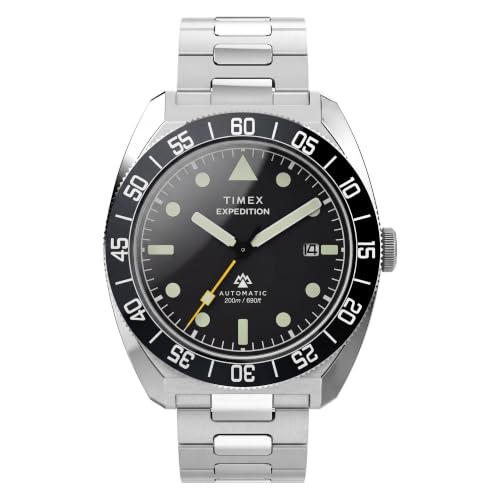
Sapphire and 200m together at this price is the reason this watch exists. Sapphire does not pick up the fine hairlines that make a watch look tired at three years, and 200m with the crown done up means swimming, showering and snorkeling are non-events rather than small decisions.
This question gets asked in almost exactly these words: I like the look of the Timex, am I giving something up by not buying the Seiko? It is a good question, because the two watches are close enough in price and purpose that preference really can be the deciding factor — and because the honest answer is not "no".
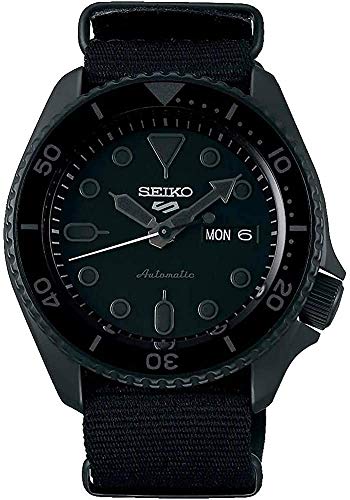
The Seiko 5 Sports SRPD55 is the watch recommended to more first-time mechanical buyers than anything else in this category, and it has earned that. The Timex Expedition Pioneer Automatic is newer, cheaper to buy, and carries two specifications the Seiko does not: a sapphire crystal and a 200m rating.
Run them through the six published specifications this site scores every watch on and they finish level. Both print 8.0. That is not a fudge — it is the shape of the trade. The Timex takes crystal by 1.2 points and water resistance by 0.4. The Seiko takes warranty by 0.7 and cost-to-keep transparency by 0.8. The totals land within a tenth of each other and round to the same number.
So the question is not which watch is better. It is which half of that trade you would rather own, and the two halves fall on opposite sides of year one: the Timex's advantages are things you notice immediately, and the Seiko's are things you notice the first time something goes wrong.
On prices: every buy button on this page reads its figure from the live price layer and stamps the date it was checked, or else reads "Check price on Amazon". No price is written into this text. Service figures quoted here are the manufacturers' own published rates.
How we picked
We have not worn these watches. What follows is what we checked instead, on documents you can open yourself — the same criteria, in the same order, on every roundup on this site. The full method is on the methodology page.
01Crystal
Sapphire against Hardlex. Seiko's hardened mineral beats ordinary mineral and is still well short of sapphire, and this is the one specification you cannot change later for sensible money.
02Is the caliber named
Seiko states a 4R36, 24 jewels, 41 hours. Timex says "automatic" and publishes no caliber and no reserve, so there is nothing to look up.
03Published service price
Seiko publishes a flat $176 to overhaul a 4R. Timex publishes nothing. This is the line that cancels out the crystal.
04Water resistance
200m against 100m. Both are real ratings from makers that publish them, and both are more than most owners will use.
05Warranty term
Three years against one, and the Timex year explicitly excludes the crystal, strap, case and battery.
06What is identical
A stainless steel case, an automatic movement that hand-winds, a standard even lug width, and both on Amazon with a live price today.
Quick picks
Ranked on the Keep Score below — six published specifications, weighted identically on every page. The last row is the one we would not buy.
Prices as of October 12, 2026. Amazon pricing changes without notice — the figure on the listing is the one that counts.
Keep Score is arithmetic, not opinion — six published specifications, weighted the same way on every page. The formula is on our methodology page, so you can re-run it yourself.
Sapphire and 200m together at this price is the reason this watch exists. Sapphire does not pick up the fine hairlines that make a watch look tired at three years, and 200m with the crown done up means swimming, showering and snorkeling are non-events rather than small decisions.
20mm is the most common strap size in the world, so the watch can be re-strapped cheaply forever. On a buy-it-for-life measure that matters more than most spec-sheet features.
Timex publishes no caliber and no power reserve. The product page says "automatic" and stops. You cannot look up what is inside, whether parts exist, or what a rebuild costs — which is the single number this site was built to find.
The one-year warranty explicitly excludes the crystal, strap, case and battery, which is the thinnest cover of anything on this page. It is also the biggest watch here at 48mm lug-to-lug and 14mm thick.
Sapphire and 200m for the money is real. What Timex does not publish is the caliber — which means you cannot look up what an overhaul costs before you buy, and that is exactly the number this site exists to check.
Manufacturer specifications for the Timex Expedition Pioneer Automatic 41mm TW2Y87400
Movement
Automatic (caliber not published by Timex)
Power reserve
Not published
Case
41mm stainless steel
Lug-to-lug
48mm
Thickness
14mm
Lug width
20mm
Crystal
sapphire
Water resistance
200m
Warranty
1 year
Timex's one-year warranty explicitly excludes the crystal, strap, case and battery.
The 4R36 is named, hand-winds, hacks, and is the most commonly serviced mechanical caliber in the United States. Every independent watchmaker has had one apart, so a service is a known job rather than a quote.
Seiko publishes a flat $176 to overhaul it. That one published figure lets you price twenty years of ownership before you spend anything, and it is the only full-marks score on this page for cost-to-keep.
Three years of cover against the Timex's one, and a 46mm lug-to-lug that is 2mm shorter than the Pioneer's despite the larger 42.5mm case diameter. It is the better-fitting watch of the two.
Hardlex is the compromise and Seiko has never moved off it at this price. 100m is the other: ample for swimming, short of the Timex. On the bracelet it is also a heavy watch — the registry figure is 170 grams.
The 4R36 is the most commonly serviced mechanical caliber in the United States and Seiko publishes a flat $176 price to overhaul it. That single fact does more for a twenty-year horizon than any spec on the case.
Manufacturer specifications for the Seiko 5 Sports SRPD55
Movement
Seiko 4R36, automatic with manual winding, 24 jewels
It fails this page because it is not the watch in the question — but if the Seiko's weight is what puts you off it, this is the same watch with that problem removed.
Identical 4R36, identical 41-hour reserve, identical 100m rating, identical three-year warranty and the identical $176 published overhaul. The case carries a hard coating that takes the first year of scuffs instead of the steel.
It also scores 8.0, the same as both watches above, which makes this a three-way tie on our six specifications and a decision that comes down entirely to crystal, weight and what you want to know about repairs.
Same 4R36 and the same $176 published service price as every other 5 Sports, with a hard coating on the case that takes the first year of scuffs instead of the steel.
Manufacturer specifications for the Seiko 5 Sports SRPD79
Movement
Seiko 4R36, automatic with manual winding, 24 jewels
It fails this page because it is not one of the two watches asked about. It is here because it refuses the trade entirely: sapphire and 200m like the Timex, a named in-house caliber that hacks and hand-winds like the Seiko, and 22mm standard lugs.
It scores 9.0, the highest figure on this site, against 8.0 and 8.0. It is also thinner than both at 12.8mm and publishes every dimension that decides fit.
The one thing it does not have is a published service price — Orient prints none, where Seiko prints $176. If that number is why you were leaning Seiko, the Kamasu does not solve it.
On paper this is the best value in the category and it is not close: sapphire and a hacking, hand-windable in-house caliber at a price where Seiko still fits Hardlex. Orient's three-year warranty is longer than Hamilton's or Tissot's.
Manufacturer specifications for the Orient Kamasu RA-AA0004E39B
Read from the Timex product page for TW2Y87400 and the Seiko Watch Corporation product page for SRPD55.
Timex Expedition Pioneer Auto
Seiko 5 Sports SRPD55
Movement
Automatic — caliber not published
Seiko 4R36, 24 jewels, hacking and hand-winding
Power reserve
Not published
41 hours
Case
41mm, 14mm thick
42.5mm, 13.4mm thick
Lug-to-lug
48mm
46mm
Lug width
20mm
22mm
Case material
Stainless steel
Stainless steel
Crystal
Sapphire
Hardlex
Water resistance
200m
100m
Warranty
1 year, excludes crystal, strap, case, battery
3 years
Published service price
None
$176 flat, 4R caliber
Keep Score
8.0 / 10
8.0 / 10
Read from the Timex product page for TW2Y87400 and the Seiko Watch Corporation product page for SRPD55.
How two different watches tie
It is worth seeing the arithmetic, because the tie is not a coincidence of rounding — it is a genuinely even trade across four of the six lines.
The formula and its weights are published on our methodology page, unchanged across every watch on this site.
Specification
Weight
Pioneer
SRPD55
Crystal
2.5
2.5 — sapphire
1.3 — Hardlex
Movement serviceability
2.5
2.5
2.5
Water resistance
1.5
1.5 — 200m
1.1 — 100m
Warranty term
1.5
0.35 — 1 year, heavy exclusions
1.05 — 3 years
Strap standardization
1.0
1.0 — 20mm
1.0 — 22mm
Cost-to-keep transparency
1.0
0.2 — nothing published
1.0 — $176 published
Total
10
8.0
8.0
The formula and its weights are published on our methodology page, unchanged across every watch on this site.
The Timex is ahead by a tenth before rounding and both display 8.0, which is as close as two watches get here. Read the rows rather than the total: this is not two similar watches, it is two opposite ones that happen to add up the same. Our methodology page sets out how each line is scored so you can re-run it yourself.
What you actually give up: the caliber Timex will not name
This is the real answer to the question. Timex sells the Pioneer as "automatic" and publishes no caliber and no power reserve. That is not a small omission on a mechanical watch, because the caliber is what determines whether the watch has a future.
With a named movement you can find out, before you buy, whether parts are still made, whether an independent watchmaker near you will take the job, and roughly what a rebuild involves. With "automatic" you can find out none of those things. The movement inside is very probably a perfectly good Japanese or Chinese caliber — but "probably" is exactly the word this site exists to remove.
Seiko's position is the opposite and unusually generous. The 4R36 is named, documented, and in millions of watches, and Seiko publishes a flat $176 to overhaul it. That means a twenty-year cost of ownership is arithmetic rather than a guess, which is what our cost of ownership guide does with it. Automatic watch servicing and costs lists every published rate by caliber, and the list is short.
Sapphire against Hardlex, honestly
Hardlex is Seiko's own hardened mineral glass. It is meaningfully better than the ordinary mineral crystal on a cheap watch and meaningfully worse than sapphire, and on our scoring it takes 1.3 of 2.5 against sapphire's full marks.
In practice the difference shows up as fine scratches. A Hardlex crystal picks up hairlines from doorframes, desk edges and coat sleeves over a few years; sapphire mostly does not. Neither is immune to a sharp impact, and sapphire is more likely to chip than scuff when it does fail.
If the watch is going to be the only one you wear, this is the Timex's strongest argument, and it is a permanent one — you cannot upgrade a crystal later for anything like sensible money. Our sapphire versus mineral crystal guide covers the hardness difference properly.
200m against 100m, and why it matters less than it looks
Both of these are real ratings published by their makers, and both are more than most owners will ever use. 100m covers swimming, showering and getting caught in weather. 200m adds snorkeling and regular sea use.
Neither watch carries a diver's certification, which is a different and stricter regime — tested resistance to pressure, salt water, shock, magnetism and thermal shock. If you want that marking at this kind of money, the Seiko Prospex Turtle is the cheapest route, and our water resistance guide explains what each number permits.
So the Timex's extra 100m is a genuine advantage that most buyers will never cash in. It is worth 0.4 of a point here, and that is about right.
Size, weight and how they wear
The numbers invert the way you would expect. The Timex is the smaller watch on paper at 41mm against 42.5mm, and the larger watch on the wrist: 48mm lug-to-lug against 46mm, and 14mm thick against 13.4mm.
Lug-to-lug, not diameter, is what decides whether a case overhangs your wrist, so the Seiko is the better-fitting watch of the two despite sounding bigger. Our watches for small wrists page explains the measurement and lists the SRPD55 as a deliberate skip for genuinely small wrists on exactly this basis.
Weight runs the other way. On its steel bracelet the SRPD55 is a heavy watch, and if that is what puts you off it, the SRPD79 is the same movement and the same published service price in a hard-coated case on nylon at 94 grams instead of 170. It is listed above for that reason.
Which to buy
Buy the Timex if you like it. That is a legitimate answer and the scoring supports it — you are getting the better crystal and the better water rating, and preference is a real input when two watches finish level. Go in knowing that if it needs work in ten years, you will be finding out what is inside it at that point rather than this one.
Buy the Seiko if the idea of an unknown repair bill bothers you more than a scratched crystal does. You are buying a documented caliber, a published $176 overhaul and three years of cover, and giving up sapphire to get them.
And if reading this has made you want both halves, the Orient Kamasu has sapphire, 200m and a named in-house hacking automatic at similar money and scores 9.0 — the highest figure on this site. It is the answer to a question neither of these watches can win. For the wider field at this price, best automatic watches under $300 and best field watches under $500 rank all of them together.
Questions people actually ask
Would I be giving up much by choosing the Timex Expedition Pioneer Automatic over the Seiko 5 Sports?+
Yes, but something specific rather than something general. You give up a named caliber and Seiko's published $176 overhaul price, plus two years of warranty. You gain a sapphire crystal instead of Hardlex and a 200m rating instead of 100m. Both watches score 8.0 on our six published specifications, so the choice is genuinely which half you want.
What movement is in the Timex Expedition Pioneer Automatic?+
Timex does not publish it. The product page states only that the watch is automatic and gives no caliber and no power reserve, so you cannot check parts availability or service cost before buying. Seiko names the SRPD55's 4R36 and states 41 hours.
What does it cost to service a Seiko 5 Sports?+
Seiko publishes a flat $176 to overhaul a 4R caliber, which is the movement in the SRPD55. Timex publishes no service price for the Pioneer, which is why the Seiko takes full marks on our cost-to-keep line and the Timex takes almost none.
Is sapphire worth more than a published repair price?+
On our scoring they are worth almost exactly the same — the crystal gap is 1.2 points and the warranty plus service-price gap is 1.5, and the two watches finish level at 8.0. Sapphire is the one you notice every day; the published price is the one you notice once, expensively.
Which one fits a smaller wrist better?+
The Seiko, despite the larger case diameter. It is 46mm lug-to-lug against the Timex's 48mm and 13.4mm thick against 14mm. Lug-to-lug is what decides overhang, not diameter. Neither is a small watch.
Is there a watch that has both sapphire and a named caliber at this price?+
The Orient Kamasu. It has sapphire, 200m, a named in-house F6922 that hacks and hand-winds, 22mm standard lugs and a three-year warranty, and it scores 9.0 against 8.0 for both watches here. Orient publishes no service price, so it does not solve that part.
Sources
Every specification and figure on this page came from one of these documents. Where a manufacturer does not publish something, the page says so rather than filling the gap.